A Tale of Two Seam Welds: Why the Roof Gets the Final Say
If commercial roofs could talk, the seams would probably have the most to say.
They’re only a few inches wide, but they carry a big responsibility. In TPO and PVC roofing systems, seams are where everything either comes together beautifully… or where water quietly starts planning a future visit inside the building.
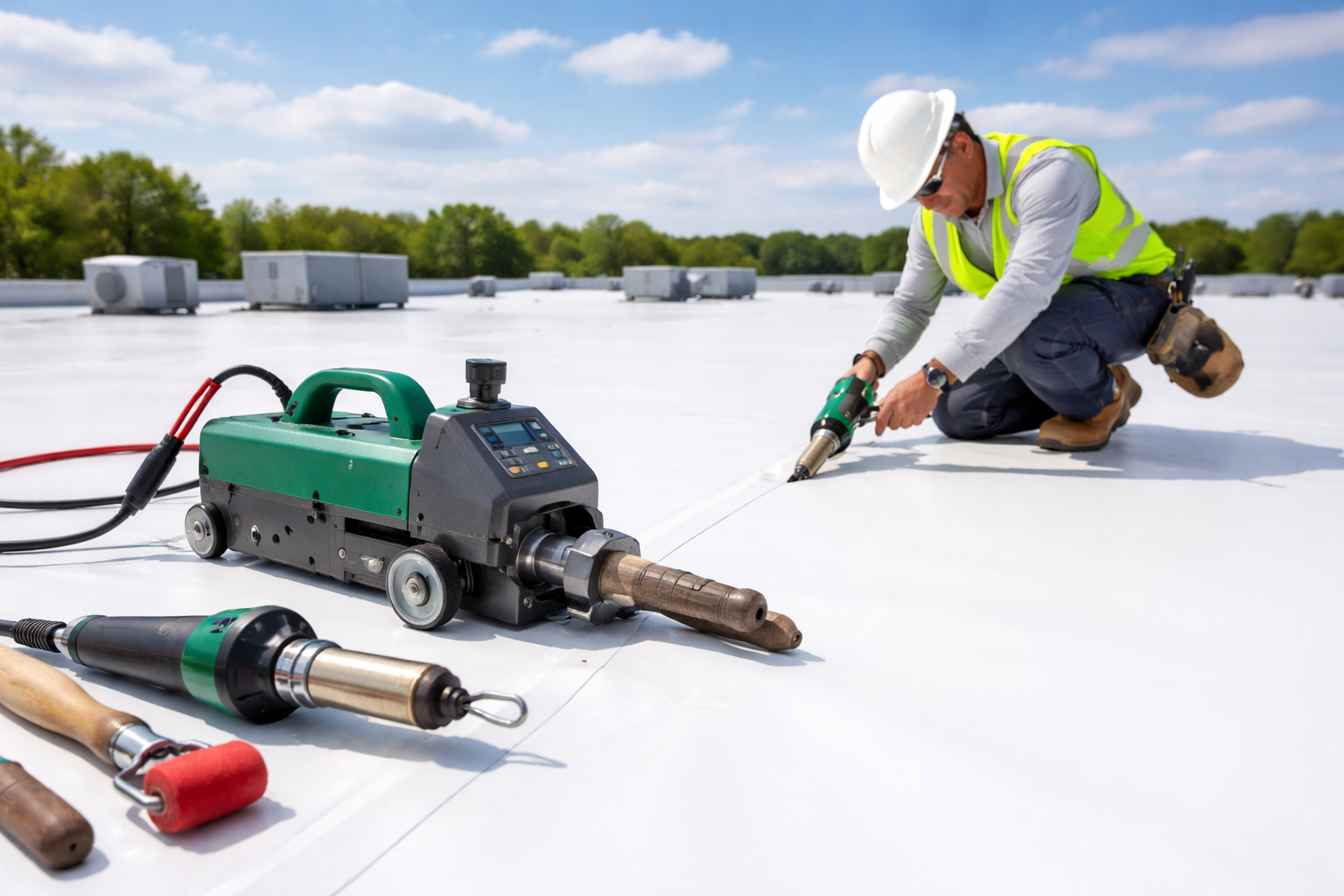
Seams are typically welded using two methods: machine welding and hand welding. Both are common in commercial roofing, and both have their place.
After decades of working on commercial roofs, we’ve learned that the real skill isn’t choosing sides—it’s understanding when each method fits the conditions in front of you.
Because membranes, much like people, don’t always cooperate exactly the way we expect them to.
When Machine Welding Works Well
Machine welders are impressive tools. On long, straight seams across smooth roof areas, they apply consistent heat and pressure while moving at a steady pace.
When conditions are right, this creates uniform, reliable welds across large sections of membrane.
Think of it as the roofing version of cruise control—steady and efficient when the road ahead is smooth.
But roofs, like roads, don’t always stay perfectly smooth.
A Note About Membrane Wrinkles
TPO and PVC membranes can develop wrinkles during installation. Temperature changes, handling, and the way material was rolled or stored can all play a role.
Wrinkles out in the field of the membrane are usually not a concern. Once the roof is exposed to sunlight, the material often relaxes and settles.
Where wrinkles deserve closer attention is inside the seam itself, where two sheets of membrane are being fused together.
When a Seam Needs a Little More Attention
A welding machine operates at a steady pace and assumes the seam surface is ready.
If a wrinkle or uneven section is present, the machine may pass over it without correcting it first. In those situations:
Heat may not reach every layer evenly
Pressure can vary across the seam
Portions of the membrane may not fully fuse
This can sometimes result in what roofers call a cold weld—a seam that looks fine at first glance but didn’t completely bond throughout.
Cold welds have a habit of behaving perfectly… right up until they don’t.
Where Hand Welding Becomes Helpful
Hand welding allows the installer to respond to what the membrane is doing in real time.
If something looks off—a wrinkle, uneven section, or seam detail—the installer can pause, adjust the membrane, and make sure everything is properly aligned before welding it together.
Because of that flexibility, hand welding is often used around:
Corners and curbs
Penetrations and drains
Transitions and tie-ins
T-joints and direction changes
Areas where a machine cannot maintain full contact
These areas naturally require a little more attention anyway.
Why We Don’t Choose Sides—We Choose the Right Tool
This isn’t really a debate about machine welding versus hand welding.
Both methods are valuable tools, and experienced installers typically use a combination of both depending on the conditions of the roof.
The goal is always the same: making sure the seam is fully fused and ready to perform for years to come. Sometimes that means letting a machine do what it does best. Sometimes it means slowing down and working through a seam by hand.
The strongest roofs usually come from crews who understand when each approach fits the situation in front of them.
At the end of the day, the strongest roofs usually have one thing in common: Someone took the time to make sure the seam was actually ready to be welded. Because when it comes to commercial roofing, seams may not talk…but they definitely remember how carefully they were made.
And after more than 50 years in commercial roofing, we’ve learned that the roofs that last the longest are usually the ones where someone took the time to listen to what the roof needed in the first place.